

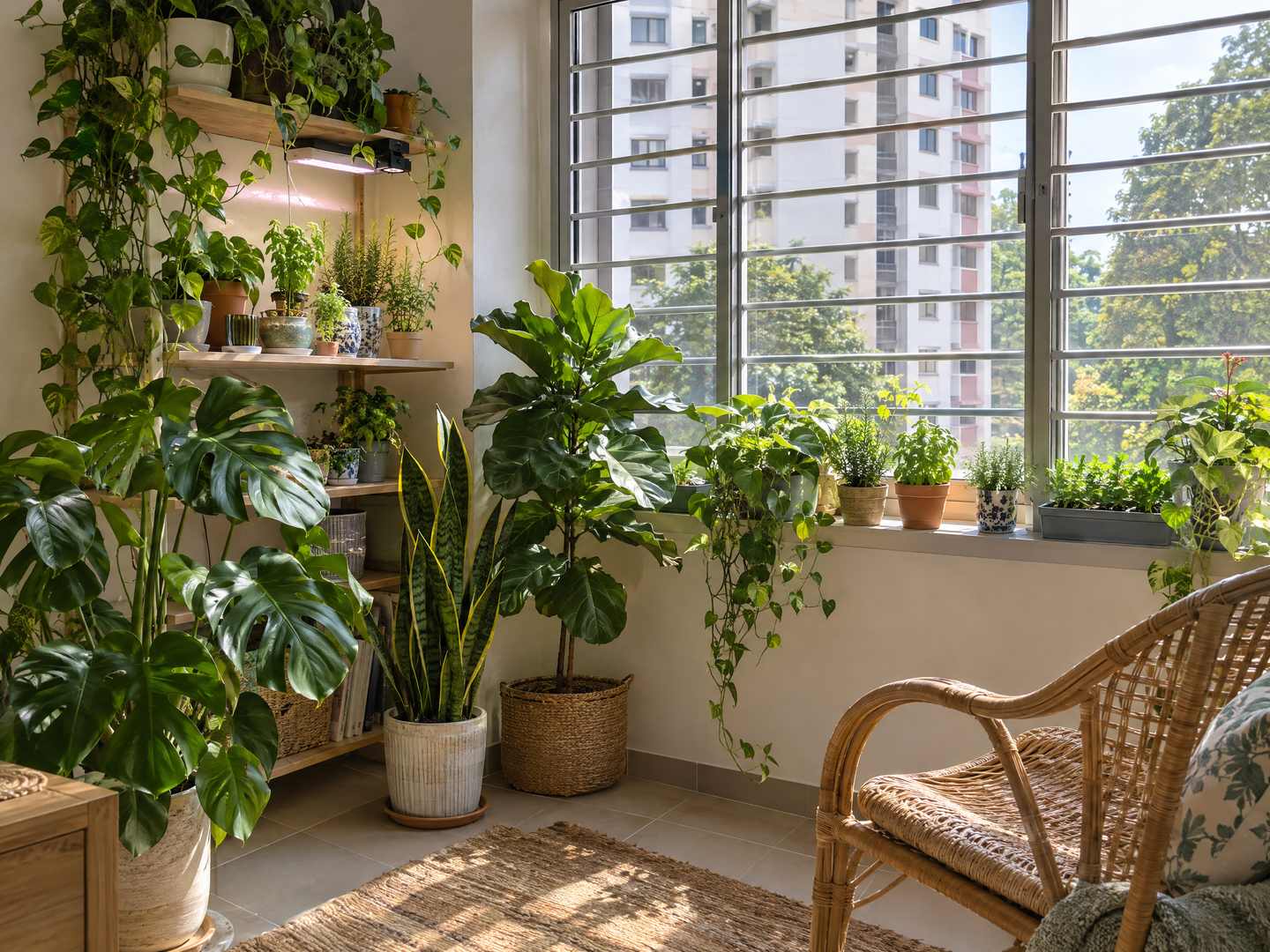
Most popular indoor plants are shade-loving, and NParks advises that a bright east- or west-facing window with about four hours of sunlight is enough for most of them. Further from the window, household LED light can help, because it contains the red and blue light plants use, at lower intensity than a dedicated grow light.
Key takeaways
- NParks says a bright east- or west-facing window with about four hours of sunlight should be enough for most indoor plants 1.
- Where natural light is not enough, NParks suggests a table lamp or grow lights, and notes that LEDs are generally preferred because they produce less heat 12.
- Snake plants and spider plants are low-maintenance choices; NParks notes the snake plant tolerates both full sun and partial shade 3.
- A plant shelf with a light built in, on its own timer, gives plants steady light and looks intentional rather than improvised.
- In Singapore, empty pot plates and loosen hardened soil so water does not sit and breed mosquitoes, as NEA advises 4.
How much light do indoor plants need in a Singapore flat?
Less than many people think, but more than a dark corner offers. NParks advises that access to a bright east- or west-facing window with about four hours of sunlight should be enough for most indoor plants, since most are shade-loving 1. Without natural light, plants may need artificial light to thrive indoors 1.
Shade-loving means a plant prefers bright, indirect light rather than strong direct sun. Many homes in Singapore have generous windows, but light drops quickly a few steps into the room, and a service yard, a corridor-facing window or a bomb shelter wall can leave parts of a flat quite dim.
Afternoon sun through a west-facing window is strong and hot. Plants that like indirect light may do better a little back from that window, or behind a sheer curtain, than right against the glass. See making the most of daylight.
How can you tell how much light a spot gets?
Look at where the window faces, how far the plant sits from it, and what blocks the view of the sky.
| Spot in the home | Typical light | What to do |
|---|---|---|
| Right by an east-facing window | Bright morning sun, gentler later | Suits most indoor plants 1 |
| Right by a west-facing window | Strong, hot afternoon sun | Pull plants back slightly or use a sheer curtain |
| A few metres into the room | Bright but indirect | Good for shade-tolerant plants |
| Corridor-facing or shaded window | Soft, limited light | Choose tolerant plants; add LED light |
| Interior corner, bathroom without a window | Little or no daylight | Plants will need artificial light 1 |
Watch a spot through a full day before you buy: a place that looks bright at 9 a.m. may be in shadow by lunchtime.
Which plants cope with less light?
Shade-tolerant, low-maintenance plants. NParks describes the snake plant as low-maintenance, growing in loose or well-drained soil and handling both full sun and partial shade without frequent watering 3. It describes the spider plant as easy to grow and low-maintenance, suited to a pot or a hanging display 3.
Even these need some light: "low light" never means "no light". For other shade-loving plants, ask a nursery for ones that prefer bright, indirect light, and check NParks' gardening resources for care notes.
Can ordinary LED lights help plants grow?
Yes, to a point. NParks notes that household LED lights contain the red and blue wavelengths plants need for photosynthesis, although at lower intensity than grow lights 2. Photosynthesis is the process plants use to turn light into energy.
LED grow lights are modified to produce more light in the red and blue wavelengths, and NParks says LEDs are generally preferred because they produce less heat; plants can burn if they grow too close to or touch very hot bulbs 2. NParks also notes that LED lights can be put on a timer to control how many hours of light plants get 2.
| Light source | What it offers | Best for |
|---|---|---|
| Daylight from a bright window | The strongest, fullest light | Most indoor plants 1 |
| Household LED light | Red and blue light at lower intensity 2 | Topping up shade-loving plants in dimmer spots |
| LED grow light | More red and blue light 2 | Plants far from windows or in windowless rooms |
How many hours a plant needs depends on the species, so check its care notes rather than relying on a single rule.
How do you build plant lighting into a renovation?
Plan it like any other feature: decide the spot, then the light, then the power. A plant shelf, niche or planter wall with a light built in looks considered, and it keeps cables and lamps out of the way.
- Choose the spot with your interior designer, ideally where the plants will also be seen and enjoyed.
- Build a light into the shelf or niche above the plants, set back so it lights the leaves without glaring into the room.
- Keep the light clear of the leaves, so growing plants never touch it 2.
- Give it its own circuit and timer, so the plants get the same hours every day, whatever the room's lights are doing.
- Use finishes that tolerate water and soil, such as sealed timber, stone or tile, with no power points where water may splash.
New lighting points should be installed by a licensed electrical worker (LEW), an electrician licensed by the Energy Market Authority. See lighting artwork and feature walls and layered lighting.
How do you keep plants healthy in Singapore's heat and humidity?
Keep water moving, not standing. Singapore's warm, humid climate suits many tropical houseplants, but standing water breeds mosquitoes and still, damp air invites mould.
- Empty pot plates and scrub them to remove mosquito eggs, or avoid using plates where you can 4.
- Loosen hardened soil so water does not collect on the surface 4.
- Change water in vases regularly and scrub the inside 4.
- Keep air moving with a fan or open window, and avoid overwatering. See humidity, mould and the smart home.
- Keep plants out of the direct path of the aircon, where the airflow is strong and cold.
Before a long trip, NEA advises making sure pots, plates and trays do not collect water after watering, and asking someone to check the home regularly 4.
How do plants and room lighting work together in the evening?
Let the plants become part of the room's evening scene. A soft, warm light grazing a large plant or a planter wall casts leaf shadows on the wall and adds depth to a compact living room.
- Graze, do not spotlight: Light from the side or below shows the shape of the leaves.
- Keep the plant's growing light separate: The shelf light runs on its own timer for the plants; the room's scenes are for people.
See designing lighting scenes.
Our honest advice
Put light-hungry plants by a bright east- or west-facing window, choose shade-tolerant plants for dimmer corners, and build a light into any plant shelf or niche on its own timer. Plan that circuit and the power point during the electrical works, so nothing has to be added later with visible cables.
For the room itself, plan the greenery as part of your lighting design. Maxsen's standard tunable white (2700K–6000K) with 0–100% smooth dimming lets an accent on a planter wall sit bright and fresh by day and soft and warm by evening. Mention any plant shelves or planter walls at the first planning visit, so the switch panel and scenes are designed around them.
Planning a smart home in Singapore? Maxsen plans, installs and hands over every home with its in-house team, over five visits.
FAQ
Do I need a special grow light for indoor plants?
Not always. NParks notes that household LED lights contain the red and blue wavelengths plants use, at lower intensity than grow lights, so they can help shade-loving plants in dimmer spots 2. Plants far from any window may need a dedicated grow light.
Which direction window is best for indoor plants in Singapore?
NParks says a bright east- or west-facing window with about four hours of sunlight is enough for most indoor plants 1. Afternoon sun through a west-facing window can be strong, so some plants do better set back a little.
Can plants survive in a room without windows?
Only with artificial light. NParks notes that without access to natural light, plants may need artificial lighting to thrive 1.
How long should a plant light stay on each day?
It depends on the plant, so check its care notes. NParks suggests putting LED lights on a timer so the plants get a consistent number of hours 2.
How do I stop indoor plants from breeding mosquitoes?
Empty and scrub pot plates, or avoid them, and loosen hardened soil so water does not pool on top, as NEA advises 4.
Sources
- "Introduction to Indoor Gardening." National Parks Board. gardeningsg.nparks.gov.sg
- "Grow Lights." National Parks Board. gardeningsg.nparks.gov.sg
- "Know 10 House Plants." National Parks Board. gardeningsg.nparks.gov.sg
- "Other Preventive Measures." National Environment Agency. nea.gov.sg


